(Korean: 최홍희; 9 November 1918 – 15 June 2002) was a South Korean Army general and martial artist who played a significant role in the history of the Korean martial art of Taekwondo.
Picture: Calligraphy of Taekwondo in General Choi's office, 29th "Fist" Division on Jeju Island.
Left: Kim Bok-man, Choi Hong-hi, Nam Tae-hi, Lee Yoo-sun
November 9, 1918
Choi Hong Hi was born in Dae-Hwa, Myong-Chun District (now part of North
Korea). He was a weak and sickly child. According to the Western calendar, this
date corresponds to December 22, 1918, but Choi chose to celebrate his birthday
on November 9.
1930
Expelled from school for protesting against Japanese authorities.
Began cooperating with the Korean student independence movement in Kwang-Ju.
His father sent him to study calligraphy under Han Il Dong, who was also a
master of Taek Kyon.
Han Il Dong began teaching Choi Taek Kyon to improve his physical condition.
1936
Choi was sent to Japan for higher education. After an altercation with a
professional wrestler, he became more determined to master martial arts.
In Kyoto, he met Mr. Kim, a Korean who introduced him to Shotokan Karate.
1938
Earned a black belt in Karate, later achieving 2nd Dan after intensive
training.
October 20, 1943
Forced to enlist in the Japanese army. Stationed in Pyongyang, he joined the
Korean independence movement (Pyongyang Student-Soldier Movement).
1944
Arrested and imprisoned by Japanese authorities. Initially sentenced to seven
years, later changed to a death sentence scheduled for August 18, 1945.
April 1945
While in prison, Choi began developing techniques for a new martial art. August 15, 1945
Japan surrendered, ending WWII. Choi’s death sentence was annulled just three
days before execution. He was released and moved to Seoul, organizing a meeting
of student-soldiers.
January 1946
Appointed lieutenant in the newly formed Republic of Korea Army.
Became company commander in Kwang-Ju (4th Infantry Regiment), where he taught
Karate to soldiers.
Later transferred to Taejon (2nd Infantry Regiment), where he also trained
American troops.
1947–1949
Promoted to captain, then major, and eventually lieutenant colonel.
Appointed chief of logistics in Seoul and martial arts instructor for American
military police.
Visited the U.S. (Fort Riley Ground General School) and demonstrated martial
arts publicly.
June 23, 1950
Completed military school in the U.S.
June 25, 1950
The Korean War began with the North's invasion of the South.
1951–1953
Promoted to brigadier general.
Deputy commander of Ground General School in Pusan.
Chief of Staff of the 1st Army Corps.
Escorted General MacArthur during his visit to Kang Nung.
Commanded the 5th Infantry Division during the ceasefire.
Authored the first official book on military intelligence.
Founded the 29th Infantry Division on Cheju Island, which became a center for
Taekwon-Do in the military.
1954
Founded Oh Do Kwan ("Gym My Way") for military martial arts training.
Led Chong Do Kwan ("Gym Blue Wave"), the largest civilian martial
arts gym in Korea.
Promoted to major general.
With Nam Tae Hi, began developing the modern Taekwon-Do system.
April 11, 1955
Gathered Korean martial arts masters to name his new martial art: Taekwon-Do.
Introduced Taekwon-Do to the public as a modern martial art and system of
self-defense.
1959
Led a successful tour of the Far East with 19 black belts.
Appointed President of the Korea Taekwon-Do Association and Deputy Commander of
the 2nd Army in Tae Gu. Visited Jhoon Rhee’s Karate Club in San Antonio—Rhee became the first
Taekwon-Do instructor in the U.S.
Returned to Korea as Army News Director and later led the Command School for
various military branches.
29th Division Taekwondo Origin and monument
General Choi created a map of the Korean Peninsula in 1953, drawing his own fist on it to represent the 29th Infantry Division of the Republic of Korea Army.
The first President of the Republic of Korea, Syngman Rhee, presenting the 29th Division flag to Division Commander gen. Choi
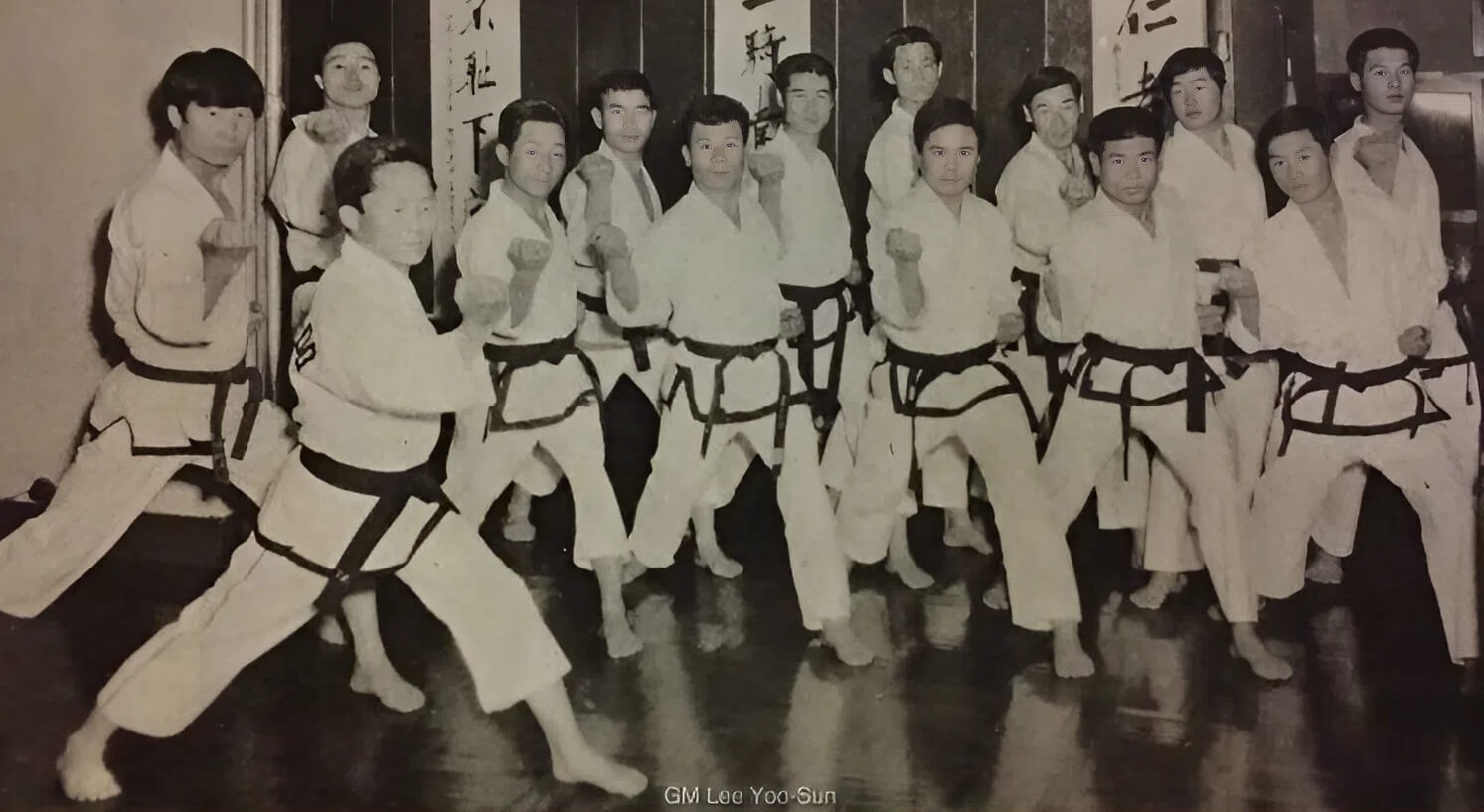
President ITF General Choi Hong-hi and his staff and instructors, the picture taken on March 22, 1966 (marked GM Lee Yoo-sun)
1961–1962
Taekwon-Do matured alongside Choi’s military career.
1962–1965
Appointed ambassador to Malaysia, where he spread Taekwon-Do and developed its
patterns. Founded the Malaysian Taekwon-Do Association (1963).
Introduced Taekwon-Do at the UN Headquarters and to the Vietnamese armed
forces.
Founded the Singapore Taekwon-Do Association (1964).
Led a goodwill mission to Europe and the Middle East.
Became President of the Korean National Taekwon-Do Association.
March 22, 1966
Founded the International Taekwon-Do Federation (ITF) with
member countries including Korea, Vietnam, Malaysia, Singapore, USA, Turkey,
Italy, Egypt, and West Germany. Elected ITF President.
1967–1969
Received the 1st Class Distinguished Service Medal from Vietnam.
Held exhibitions in France and other countries.
Awarded by the Korean government for his contributions to sport and martial
arts.
Taekwon-Do was practiced in 67 countries.
Held the first Asian Taekwon-Do Tournament in Hong Kong.
Began work on his book Taekwon-Do (published in 1972).
1972
Went into voluntary exile in Canada due to political misuse of Taekwon-Do by
President Park Chung Hee. Park’s regime attempted to use Taekwon-Do for propaganda.
1973
The World Taekwon-Do Federation (WTF) was formed in South
Korea under Park’s directive, led by Kim Un Yong. October
1974
Held the 1st Senior ITF World Championship in Montreal, Canada.
November 1976
Held the 1st ITF European Championship in Amsterdam. 1977
Publicly criticized President Park Chung Hee in Tokyo for politicizing
Taekwon-Do. 1979
Founded the All European Taekwon-Do Federation (AETF) in Oslo,
Norway. 1980
General Choi Hong Hi, accompanied by fifteen students including his son Choi
Jung Hwa, undertook a historic "Goodwill Mission" to the DPRK (North
Korea). This marked the first introduction of Taekwon-Do in the country. May 20, 1981
A formal request was made for the inclusion of ITF Taekwon-Do in the Olympic
Games. 1982
General Choi visited Czechoslovakia, accompanied by Masters Han Sam Soo and
Park Jung Tae. January 1983
General Choi awarded Charles E. Serrefovi, President of the U.S. Taekwon-Do
Federation, the 7th Dan. February 8, 1983
General Choi received a letter from IOC President Juan Antonio Samaranch,
encouraging the merger of ITF and WTF under a single organization.
In the same year, Choi published the first edition of the Taekwon-Do
Encyclopedia, a comprehensive 15-volume work containing nearly 5,000 pages
and detailing 3,200 techniques. June 29, 1985
A meeting between ITF and WTF took place but ended without resolution. 1990
General Choi parted ways ideologically with Master Park Jung Tae, who went on
to establish the Global Taekwon-Do Federation (GTF) and became its first
president. 1994
ITF and General Choi organized the first international Taekwon-Do seminar in
the Czech Republic, held at Charles University in Prague. 1997
General Choi released a Multimedia Encyclopedia of Taekwon-Do on four CD-ROMs. 1998
The second ITF international seminar in the Czech Republic was held again at
Charles University in Prague. 1999
General Choi was appointed President of the International Martial Games
Committee (IMGC).
June 25–27, 1999
The third and final ITF international seminar in the Czech Republic took place
in the town of Třeboň, South Bohemia. April 11, 2002
Master Park Jung Tae passed away from cancer, just as discussions about his
potential return to ITF were beginning. June 15, 2002
General Choi Hong Hi passed away from cancer at the age of 84 in Pyongyang,
where he was also laid to rest.
Following his death, the ITF split into three separate organizations led by
Chang Ung, Choi Jung Hwa, and Trân Trieu Quân.
1970 Gen. Choi and instructors in Seoul, GM Lee Yoo-sun left
The first President of the Republic of Korea, Syngman Rhee, presenting the 29th Division flag to Division Commander gen. Choi and solders